“Prolix Logorrhoea, and how!”

Wednesday, September 24, 2008

L.ife S.ucks D.arling

From the "Can't Leave Well Enough Alone" Dept., A.C.R.O.N.Y.M. Inc. are now making these long-since out-of-print Zines available, to you, again:


L.ife S.ucks D.arling #1
(Essay / Collage color electronic version available
5.5" x 8.5"
$1.00)


Soylent Green & Olaf D. Neeper are actually Austin Rich & Syd Louse (of Cathead). This relic from 1995 was assembled in "merely two hours," fueled by coffee and our increasingly psychedelic views of the world around us. This one is worth the price for the Nixon Collage alone.


* * * * * *


L.ife S.ucks D.arling #2
(Essay / Collage color electronic version available
5.5" x 8.5"
$1.00)


Spurned on by a fan who wrote in to receive their free plastic spoon (stolen from McDonalds, late at night I might add), we went ahead and created a second issue, this time with Garl P. Snodgrass (kiisu d'salyss) in tow. The M.O. is pretty much the same, except this issue contains a few different versions of Pete The Junky Duck (for no discernible reason, I might add).


* * * * * *


Special Two-For-One Deal!
(Essay / Collage black and white print or color electronic version available
5.5" x 8.5" staple bound
$2.00)


Reprinting all the material from both issues of L.ife S.ucks D.arling, this collection is your one stop shopping for late-night shenanigans and insomnia-fueled cut-n-paste work. All for the low price of $2.00, American.

mall (môl), n., an enclosed shopping center

Long-since out of print, A.C.R.O.N.Y.M. Inc. is proud to retrieve this lost gem from 1998:

mall (môl), n., an enclosed shopping center
(Essay / Collage black & white print
or color electronic versions available
4.5" x 3.66", staple bound
$1.00 includes shipping)


For many years I worked in a Mall. (First, at Gateway in Springfield, OR, and then at the Lloyd Center here in Portland.) I wrote this 'Zine one day, at the Mall, to help vent some frustrations, and looking at it now it's held up pretty well. Now it can be yours, and electronic purchases are in COLOR for the first time ever! Be the first on your block to know all about the enclosed shopping center that is near and dear to us all.

Monday, September 22, 2008

Vampire Punks!

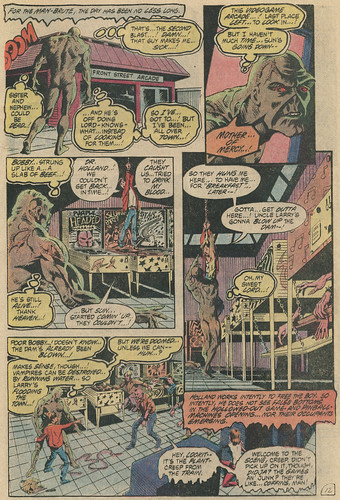
The cover, and two interior pages, from Swamp Thing #3, July, 1982. (For higher-resolution scans, try my Flickr Page. In this issue, Swamp Thing fights for his life against Vampire Punks from the small town of Rosewood, Illinois. (I hear they had a wicked hardcore scene back in those days.) Our protagonist runs up against Stiv Slashers, a kid who is turned into a vampire by a hitchhiker. He in turn infects his girlfriend X-Head, who works at the local Blood Bank. Together, they reduce Rosewood to a town of Vampire Punks that terrorize any of the humans left behind. Swampy, being the agreeable moss-encrusted creature that he is, decides to give these punks What For. (My favorite detail in this issue: the Punks live in the Front Street Arcade, and sleep inside of old Pinball Machines during the day.)

Almost as good as the images / dialog from this issue is an exchange in the letters page which showed up in issue #8:

I just read SOTST #3 and was not all that pleased with it. When I first heard of the Punk-rock vampires that were to be in this issue, I thought it would be rather funny. I was, at least, a bit disappointed. I can't say I agree with the way you portray punks. Contrary to what Phil Donahue, Penthouse, and the Today show say, not all punks are self-destructive junkies.

At the end of the story you have Swamp Thing say, "...You're too decent... you're the promise of what this town could be...!" Does this mean that it would be far better to have a world of decent, clean-cut American boys than it is to have a bunch of unsightly Punk rockers? A lot of people apparently think so, and I'm glad to say I don't agree. The next time you do a story with punks in it, keep in mind that you can't believe everything you read or see on television.

Mark "Sid" Pfaff
234 S. 6 West
Missoula, MT 59801

Editor's Response: To Mark - or "Sid": We thinks thou dost protest too much. The word "punk" never appeared in the story, fella; that's your label, not ours. And what Alec [Swamp Thing's alter ego] was so disturbed by was an apparent world-view, not a style of dress. You, as a self-proclaimed "punk," seem focused on appearance, however - and something that superficial was not at all what concerned the characters in the story.

Not only is "Sid" sort of missing the point (this has nothing to do with the comic's portrayal of punks, but of punks who have turned into vampires and have no soul), but the editor takes a pretty self-righteous attitude toward "Sid" in his response (reading between the lines: the editor understands that appearances do not a person make, but accuses "Sid" of making his assumptions based on the way the way the Vampire's Dress). This little sequence (and the letter than it provoked) was one of the more entertaining things about Swamp Thing in these early days.

Interesting factoid: Stiv Bators, the Vampire Punk's namesake, had just started The Lords of The New Church a year before this issue came out. At the time, Stiv was incorporating the stage show of the Dead Boys with a more New Wave / Pop sound, which lead to him becoming a bit of an icon in the music world, even in the mainstream. Considering that Iggy Pop was experiencing some downtime, career-wise, it makes sense that Stiv might be the most recognizable punk icon at the time this writer set to work on Swamp Thing.

And that's one to grow on.

Monday, June 9, 2008

The Unknown Comic

During my usual lunch-break Wikipedia perusals, I was inspired to look up and find the following entry, mostly because it occurred to me that I knew nothing about him:

The Unknown Comic

And then, to my astonishment, I came across my new favorite picture of a celebrity, ever:

Ahhh, the Inter-web. What a time to be alive!

Monday, February 11, 2008

Lost - Season 1: A Personal View

Music: Negativland - Over The Edge Podcast

Having come of age in the 1980's, it's nearly impossible for me to imagine a time when "Silent Cinema" would even be a possibility. The notion that audio and video were, in the beginning, separate makes sense now, but as a kid I would never have thought to think of them that way. Sound in film was so pervasive, so complete, and so ingrained in the experience of watching a movie that I never even paid attention to the way sound functions until I began taking film classes.


Fans are already aware of this, but sound is a HUGE element of Lost, and not just the musical score (though that plays a big part in the show, too). For a show that is as convoluted, sprawling, and interconnected as it has become, the act of watching a single episode often becomes an epic unto itself, sifting through clues and plot-points to try and connect what has happened with what is happening. To help make this easier, sound (and the way it's used) helps guide viewers through the garbled layers of the show, and encodes the experience of watching it with audio-cues that adjust our viewing experience as we bob and weave our way through any given episode.


Like with many things that I enjoy, the humble beginnings are never perfect, and Season One of Lost is no exception. As the show stumbles to gain solid footing during it's first cautious outings, it is hard not to feel that something is "off" as the Season progresses. My first impression was that the Season merely started slow. It wasn't until 11 episodes in that I really felt like the show hit it's stride, and even then the style, form, and flow didn't really begin to become codified until near the end of the Season (which is carried over into Season Two, and becomes the dominant form the show takes). With a single viewing, it's easy to see many of these growth spurts as indicators of the art and artifice trying to maintain the right balance. However, with an ear for the sound and how it's used with regards to Hurly, Season One manages to communicate to us so much more than what is on the surface.

In the opening scenes of the Pilot episode, Jack is the character we meet first, and for many he is the point of entry when it comes to the world of the show. He is central to most of the storylines, appears in a larger number of flashbacks than most, and quickly becomes the leader of the main characters. But, more realistically, Hurly serves the function of our in-story proxy much better than Jack. Lost fans are, if anything, pop-culture junkies, searching for clues in the referenced media within minutes of the show's initial broadcast. We connect to his interests because they are our interests. And, unlike Jack, we have more in common with the skillset Hurly has at his disposal. Chances are, we are not Doctors or Leaders of that kind, and when faced with survival on an Island, wouldn't have many practical skills to contribute to the cause. Instead, we ARE good at looking for ways to relieve stress, pusuing interests for fun, and nit-picking about Star Wars... just like Hurly.

While the mysteries of the Island are not unfathomable, even for someone "in the know" they are extremely difficult to make sense of, an element of the show the writers are highly attuned to. The structure makes sure this does not overwhelm us with regards to this aspect of the show: each little mystery is revealed one at a time, adding to what we already know while never completely illuminating everything. This makes it easier to take, for both the characters and the audience. If first-time viewers were suddenly dropped into the middle of a story involving an Island-Monster, mysterious residents, and a "Hatch" that rapidly becomes the obsessive focus of the weirdest person you know, it would be far too easy for those viewers to change the channel. To keep us tuned in, these plot-elements are revealed one at a time, and slowly. And to help ease viewers into these mysteries, we are guided by the clever use of sound.

Lost
utilizes sound in a variety of ways to help direct our experiences as viewers. Primarily this is achieved through the use of diegetic sound, elements that have a source that all the characters can hear and interact with. (Dialog, crashes, explosions, a radio playing, etc.) The show also employs sountrack music to wonderful effect. The score is both creepy and beautiful, compelling and nerve-bending, horrific and mundane, and always at the service of the story. This music is always non-diegetic: the characters cannot hear it because it only exists as a sound-texture to contrast against / work with the images we see on the screen. The effects of this sound, then, can only really be understood in relation to us, and the way we interact with what we see / hear on screen. Nearly every piece of film produced now has at least some diegetic sound elements, and more often than not, non-diegetic ones, too.

In Lost, sound is used in two additional ways to a tremendous effect, first with non-/diegetic sound sources evolving from one to the other, and second with the "cues" used to indicate the beginning and end of a flashback. The flashback cues are a unique feature of Lost; they are entirely non-diegetic, but rather than working with the images on screen to create an emotional response, their entire function is to telegraph the beginnings and ends of Flashbacks. This sound is never heard by characters on-screen, and while they are heard in conjunction with on-screen images, rarely does this cue work to give us emotional insight into what we've seen. This becomes extremely helpful as the show progresses. While the flashbacks in and of themselves are rarely difficult to make sense of, the cue clarifies to us (within an already confusing narrative) what is "real-time" vs. "flashback." (Or, in the case of the end of Season 3 "flash-forward.")

In the first 17 episodes of Season One, Lost uses the American Audio-Montage technique to "wrap-up" more than a few of their stories. For a first-time viewer, this schmaltzy ending comes off as extremely corny, like an element of the WB's / CW's Prime-Time Soap form of storytelling, where a pop song is used to convey how everyone feels much more effectively than "dialog" or "story." In three specific cases, these audio-montages in Lost begin as diegetic sound that evolves into a non-diegetic source, and in all three cases, the sound begins as a song that Hurly listens to on his CD Player.

The effect of the use of this convention on-screen works as a means of reinforcing Hurly's role as our in-show proxy. Through the simple act of listening to a song, Hurly triggers an audio-montage that we are led-through, and summarizes the emotional trajectories of the characters through his careful selection of songs. After all, Lost is not something you can just jump into, and by easing us into the kind of show that it becomes near the end of the Season, we are able to better acclimate to this with Hurly as our guide. Very quickly, when there is a pop-song playing, it works as a "cue" to indicate that what we are seeing is now from his POV.

With this in mind, the ending of the third episode takes on a much more Lost sense of structure than the schmaltzy audio montage would indicate. In the closing scene of the episode, Jack suggests to Kate that everyone on the Island gets to "start over," and when Hurly listens to his CD Player, everyone appears to be doing just that: the tensions between Jin & Sun, Shannon & Boone, Sayid & Sawyer, Michael & Walt (& Locke), etc., all seem to have melted away in favor of a family-drama kind of closure. The first time through this scene, one is struck with a sense of how much like the rest of one-hour television it actually looks.

However, a closer look reveals that this pop-pap moment conveys something else entirely: we know that Jack is wrong, as the emphasis on flashbacks illustrates that who they were is as important as who they are, now (or, at least, the former informs the later). And while everyone seems to be ending this particular episode "happily ever after," anyone who watches past this episode (or even past the audio-montage to hear the end-credits theme music) knows that the problems and tensions that everyone faces are nowhere near close to being resolved. It only appears to end that way because, for Hurly, that's how he wants to see it. His upbeat character and happy-go-lucky attitude manages to affect even the POV of the audience.

When he listens to his CD Player in the sixth episode, we already know that the POV has switched to that of Hurly's, but the tone is drastically different this time. The song itself says it all, "Are You Sure (This Is Where You Want To Be?)" by Willie Nelson. At the end of a story about making choices about where to live (the caves or the beach), Hurly's Audio-Montage leads us through a series of close-ups that illustrate the outcome of everyone's decision. No one is happy, not even Hurly, who is normally able to go with the flow. While the song works perfectly in the context of the episode, it also works to further drive home the point that everyone wants off the island. Our relationship to the show is also aptly summarized, too: the real story is about to unfold, and we are left asking ourselves if this is the kind of show we want to be watching.

Like the set-up of a well-told joke, the third and last time Hurly attempts an Audio-Montage is in episode 17. Much has happened, story-wise, since this gimmick has been used before, and as viewers we have become invested in the mysteries despite the actual amount of screen-time they may have been given. Initially the montage appears very much like the ones we've seen before: Michael and Jin set aside their differences to work together on rebuilding the boat. Shannon & Sayid appear to be working on their budding relationship, etc. But we've just seen Boone warn Sayid about just that, and we know this is by far the happiest resolution for everyone. Then we see Sun, alone, nervously flaunting a freedom she never had before, as we know that the next chapter of her story will be difficult for everyone. By the time Charlie brings Claire some water, we've already connected to the idea that their story will end anything but happy. When Hurly's CD Player finally starts skipping, breaking the fantasy entirely, we are not surprised when his batteries have run out. Hurly's last source of escapism is gone, and the mysteries of the island can no longer be ignored.

It is no wonder that the following episode is Hurly-centric, and even takes a jab at these audio-montages when we see Hurly hiking to what sounds like a Hip-Hop track. It's jarring, and we know his CD Player shouldn't be working, until we realize that the sound is actually part of the impending flashback, coming out of the stereo that Hurly is listening to in the past. We are also not surprised that from here on out, the pace of the season picks up tremendously, as if the mysteries can no longer be contained and held back through Audio Montages. In fact, in light of Hurly's connection to the numbers, our identification with Hurly not only seems to be a better way of reading Season One as a whole, but begs the question: why we weren't more conscious of this the first time through?

Friday, August 8, 2003

Gremlins

Music: Nirvana – Outcesticide (bootleg recordings... it's 1994 all over again)

Gremlins is playing at the Guild tonight, and I've been pretty jazzed about it all week. I love that movie, and have recently been honing some thoughts on the subject when I'm on the bus. In an attempt to rally the troops so they'd be interested in seeing it tonight, I wrote a little “review” of the film, which I've included below. Enjoy!

* * * * * *

Gremlins

Joe Dante practically invented the Christmas Horror movie, but with Gremlins the fact that it's Christmas -- or for that matter, a horror movie -- takes second place to his particular satiric vision. Gremlins is crammed with social satire and commentary from first scene. Over the opening credits, the first thing an attentive viewer may notice is that most of the sets are modeled after, “It's A Wonderful Life,” a point that's driven home even more by the fact that the town is “run” by a miserly old woman who loves to screw people over around the holidays. (Of course, it's only more appropriate that the mother in this film is watching “It's A Wonderful Life,” on TV, as if to further de-construct the 4th Wall in film viewing, and to serve as a “Life As Art, Art As Life” counterpoint to that particular angle.) If that weren't enough, Gremlins' own version of George Bailey is introduced immediately, seeing as how the town's greedy miser has got it in for not only him and his family, but his little dog, too.

But beyond the thematic and film allusions, it's not until the Mogwai comes home that the social commentary begins. As a typical complacent family of the '8Ø's, it's much easier to get wrapped up in their own lives than meet the needs of the family pet, a not-so-subtle jab at the problems with child-rearing in America. Christmas itself serves a particularly important focal point when it comes to pointing out our shortcomings: It's as if this small-town family is so distracted by material needs and the superficial aspects of Christmas, that the forces of nature throw a plague of Gremlins on the town in an almost biblical fashion. And then the real fun begins.

To complicate the layers upon layers of poignancy, the Gremlins themselves seem to be attracted to junk culture, violence, and the flotsam and jetsam of the '8Ø's. The more they are exposed to these inclinations, the more the second and third generation beasties become more disgusting and easier to distract. Weather it's a steady stream of beer coming to keep them docile or having them watch a movie to make them happy, it seems as if the Gremlins themselves amplify the very character traits that caused them to exist in the first place. More jabs at child-rearing, since the “parent” Gremlin seems less affected by these problems, though not entirely.

But when all is said and done, Gremlins is more a form of demented slapstick a la The Three Stooges. When push comes to shove, they think they have all the rights in the world to be as lazy and disgusting as they want, and will gladly defend those rights in the most silly and hilarious ways they can muster. But like most junk-culture addicts, the Gremlins feel their rights involve over-indulgence at all costs, and in the end it becomes their very undoing. When the soft and cuddly marketing tool of the film finally dispatches the final villain, it's only fitting that an Asian Gentleman judges the family that stars in this movie. He leaves little to recommend this -- or any -- American family, and claims that they are not ready for responsibility of this kind. Is it more film allusions, or a comment on the opinions of foreign powers regarding typical Americans? In Joe Dante's world, it's all the same, so long and the pace is frenetic and the jokes crud and funny.

And personally, I wouldn't want it any other way.

Friday, December 8, 2000

2010 Broadcast Schedule

(All Listings Tentative Until Otherwise Carved In Stone)

January 2nd: Starting Over
January 9th: Radio About Radio
January 16th: Cold Metal, Live!
January 23rd: Blasphuphmus Radio Theater Presents
January 30th: TBA

February 6th: TBA
February 13th: New Moon
February 20th: My Mother’s Birthday
February 27th: Blasphuphmus Radio Theater Presents

March 6th: It Came From Outer Space
March 13th: The Grumpy Punk
March 20th: Equinox
March 27th: Blasphuphmus Radio Theater Presents

April 3rd: Easter Special
April 10th: TBA
April 17th: Radio About Radio
April 24th: Blasphuphmus Radio Theater Presents

May 1st: May Day Special
May 8th: TBA
May 15th: It Came From Outer Space
May 22nd: Blasphuphmus Radio Theater Presents
May 29th: JFK’s Birthday

June 5th: TBA
June 12th: TBA
June 19th: The Grumpy Punk
June 26th: Blasphuphmus Radio Theater Presents

July 3rd: TBA
July 10th: TBA
July 17th: TBA
July 24th: Radio About Radio
July 31st: Blasphuphmus Radio Theater Presents

August 7th: My Sister’s Birthday
August 14th: It Came From Outer Space
August 21st: TBA
August 28th: Blasphuphmus Radio Theater Presents

September 4th: TBA
September 11th: 9/11 Special
September 18th: The Grumpy Punk
September 25th: Blasphuphmus Radio Theater Presents

October 2nd: Halloween Spook-Tacular I
October 9th: Halloween Spook-Tacular II
October 16th: Halloween Spook-Tacular III
October 23rd: Halloween Spook-Tacular IV
October 30th: Halloween Spook-Tacular V

November 6th: It Came From Outer Space
November 13th: Radio About Radio
November 20th: Blasphuphmus Radio Theater Presents
November 27th: Turkey Special

December 4th: Holiday Special I
December 11th: Holiday Special II
December 18th: Holiday Special III
December 25th: Holiday Special IV

Wednesday, August 16, 2000

2009 Broadcast Schedule (Remainder)

(All Listings Are Tentative Until Otherwise Confirmed)

August 22nd
: Summer Sounds (Two-Hour Show)

August 29th: The Grumpy Punk Part II

September 5th: 2 Hour Show (12 - 2 PM). Special Guest Ian Murray!

September 12th: Special 12 PM Broadcast: The Adventures Of Superman Part V! (Followed by a special 1 PM broadcast of "What's This Called?" featuring the Mangled Bohemians, Live!

September 19th: The Best of Holden Craft

September 26th: Cerebus The Aardvark

October 3rd: Halloween Show I

October 10th: Halloween Show II

October 17th: Halloween Show III

October 24th: Halloween Show IV

October 31st: Halloween Show V

November 7th: Daylight Savings / Election Day Special

November 14th: It Came From Outer Space Part II

November 28th: Thanksgiving Special

December 5th: Holiday Special I

December 12th: Holiday Special II

December 19th: Holiday Special III

December 26th: End of Year Special (Pre-Record)

Sunday, January 2, 2000

Schedule Reference Guide

“Of A Beginning” (Radio About Radio)
As KPSU begins syndicating “Blasphuphmus Radio,” I decided to do a show that looks self-reflexively at itself. “Of A Beginning” is the perfect place to start for people who are wondering what kind of show they can expect in the 2009 season.

Live Music

Live Music Shows are a chance to showcase some of the more impressive performances I’ve been able to record at KPSU... and beyond! While I have a wealth of material to dig through from my archive, these shows will also feature performances by touring bands and local artists, all looking for a chance to show off what they do best.

Specials
While every day is Tuesday in the eyes of the Church, 2009 offers a number of American (and International) Holidays that just so happen to fall on the holiest of Holy Days. To honor these meaningless coincidences, we’ve chosen to host Special Themed Broadcasts in order to feature various media that relates to that special occasion. Some planned Special Broadcasts include: Inauguration Day, Flag Day, St. Patrick’s Day, Mother’s Day, Father’s Day, Bastille Day, Election Day, Winter Solstice, and New Year’s Eve Eve Eve.

Blasphuphmus Radio Theater Presents
Thrill at the audio sensations of yesteryear with Blasphuphmus Radio Theater Presents! Since radio’s inception, there have been literally dozens of hours broadcasts that were “captured” to be “played back” at a later date. The diligent interns here at Blasphuphmus Radio have located some entertaining gems from radios past, and we’ll be presenting them periodically as a favor to our listeners.

Retrocasting Specials
As the occasion may warrant, Blasphuphmus Radio will put to use their Retrocasting technology to re-present previous broadcasts for modern consumption. I’ll be tuning the Retrocaster to various periods in my broadcasting past to find occasional gems and appropriate audio moments for timely reasons. This will give listeners a chance to experience the past in the present... and YOU ARE THERE!

Special Broadcasts
Halloween is one of our favorite times of year at Blasphuphmus Radio, so we’ll be planning four weeks of special Halloween Programming in the month of October. And in December, fear not! Most people are subjected to hours of programming every year, drenched in saccharine holiday sentiment that makes them feel anything but jolly. That’s why, for the month of December, we’ll be bringing you “Christmas Music For People Who Hate Christmas Music.” All the Christmas songs that express a much more realistic look at the holiday season.

Saturday, January 1, 2000

2009 Broadcast Schedule

January 6th : “Of A Beginning” (Radio About Radio)

January 13th : Live Music

January 20th : Inauguration Day Special

January 27th : Blasphuphmus Radio Theater Presents

February 3rd: Live Music

February 10th: Retrocasting Special #1

February 17th : Blasphuphmus Radio Theater Presents

February 24th : Flag Day Special

March 3rd: Live Music

March 10th: Retrocasting Special #2

March 17th: St. Patrick’s Day Special

March 24th: Blasphuphmus Radio Theater Presents

March 31st: Special Broadcast

April 7th: Live Music

April 14th: Retrocasting Special #3

April 21st: Blasphuphmus Radio Theater Prestents

April 28th: Special Broadcast

May 5th: Live Music

May 12th: Retrocasting Special # 4

May 19th: Blasphuphmus Radio Theater Presents

May 26th: Mother’s Day Special

June 2nd: Live Music

June 9th: Retrocasting Special # 5

June 16th: Blasphuphmus Radio Theater Presents

June 23rd: Father’s Day Special

June 30th: Special Broadcast

July 7th: Live Music

July 14th: Bastille Day Special

July 21st: Retrocasting Special # 6

July 28th: Blasphuphmus Radio Theater Presents

August 4th: Live Music

August 11th: Retrocasting Special # 7

August 18th: Blasphuphmus Radio Theater Presents

August 25th: Special Broadcast

September 1st: Live Music

September 8th: Special Broadcast

September 15th: Retrocasting Special # 8

September 22nd: Blasphuphmus Radio Theater Presents

September 29th: Special Broadcast

October 6th: Halloween Spooktacular # 1

October 13th: Halloween Spooktacular # 2

October 20th: Halloween Spooktacular # 3

October 27th: Halloween Spooktacular # 4

November 3rd: Election Day Special

November 10th: Live Music

November 17th: Retrocasting Special # 9

November 24th: Blasphuphmus Radio Theater Presents

December 1st: Holidaze Special # 1

December 8th: Holidaze Special # 2

December 15th: Holidaze Special # 3

December 22nd: Winter Solstice Special

December 29th : New Year Special